Products
Monocrystalline silicon differential pressure transmitter working principle
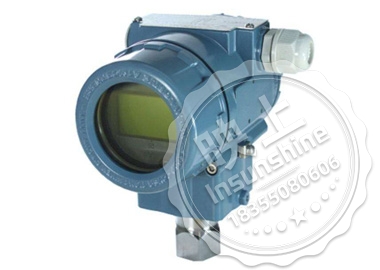
Monocrystalline silicon differential pressure transmitter is a new type of differential pressure transmitter developed in the 1980s, which utilizes monocrystalline silicon resonance sensors, microelectronic surface processing technology, in addition to ensuring the measurement accuracy of ± 0.2%, can also be achieved to resist the static pressure, temperature fluctuations on its impact. As equipped with a low-noise modem and open communication protocol, the current capacitive differential pressure transmitter can be realized digital lossless signal transmission.
1.Structure and working principle
Pressure transmitter is mainly composed of detection part and signal conversion and amplification processing part.
Detection part of the detection diaphragm and both sides of the fixed arc plate, the detection diaphragm in the differential pressure under the action of axial movement, the formation of a movable capacitance pole plate, and fixed arc plate composed of two variable capacitors C1 and C2, structure and electrical principle can be seen in Figure 6-11.
Before the test, high and low pressure chamber pressure balance, P1 = P2; according to the structural requirements, composed of two variable capacitor fixed arc-shaped plate and the detection of diaphragm symmetry, pole spacing is equal, C1 = C2.
When the measured pressure P1 and P2 respectively by the introduction tube into the high and low pressure chamber, because P1 > P2 isolation diaphragm center will be displaced, compression of the electrolyte to make the high-pressure side of the volume becomes smaller. When the electrolyte is incompressible, its volume change will cause the center of the detection diaphragm to the low-pressure side of the displacement, this displacement and the center of the isolation diaphragm displacement amount is equal. According to electrical engineering, when the spacing between the two poles of the capacitor is changed, the capacitance will also be changed, i.e. from C1=C2 to C1≠C2.
From the electrical schematic diagram, it can be seen that there is no displacement, I1 = I2 = 0; ι1 + ι2 = ιc; displacement occurs, due to changes in the relative pole spacing, the amount of charge accumulated on the pole plate also changes, the formation of charge displacement, this time reflecting the I1 ≠ I2, the two will produce a difference in the current between the two, if the detection of the magnitude of its value and its relationship with the differential pressure, you can obtain the flow rate.
Monocrystalline silicon pressure transmitter manufacturers
2. Transmission current and the relationship between the differential pressure.
Set up: when no displacement occurs, according to the definition of capacitance:
Where K - proportionality constant;
ε - dielectric constant;
S -- arc plate decision area;
d0----the relative average distance between the arc plate and the movable pole plate.
When the displacement Δd, still according to the definition of capacitance have: monocrystalline silicon differential pressure transmitter price
As can be seen from Figure 6-11, driven by a high-frequency power supply with an electric potential of e and an angular frequency of ω, the charging and discharging current difference is:
Will C1 and C2 definition expression into the above equation, there:
From the derivation of the results can be derived, the current difference and movable pole plate (detection diaphragm) center displacement is proportional to the displacement and the measured differential pressure is proportional to the current difference and the measured differential pressure and flow are proportional.
3. Capacitive differential pressure transmitter features Single crystal pressure transmitter analysis method
Capacitive differential pressure transmitter is composed of sealed measuring elements, can eliminate the mechanical transmission caused by transient impact and mechanical vibration. In addition, high and low pressure measurement chamber according to the explosion-proof requirements of the whole casting, greatly inhibit the external stress, torque and static pressure on the measurement accuracy of the impact. Pressure transmitter market applications