1、Overview
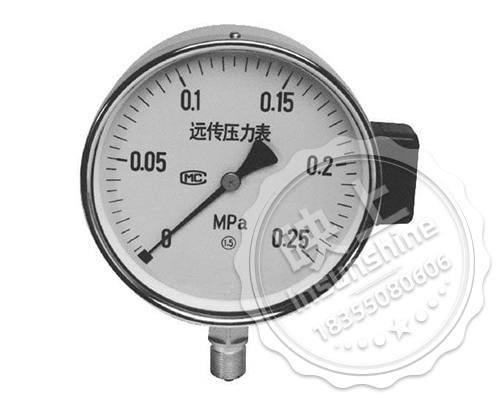
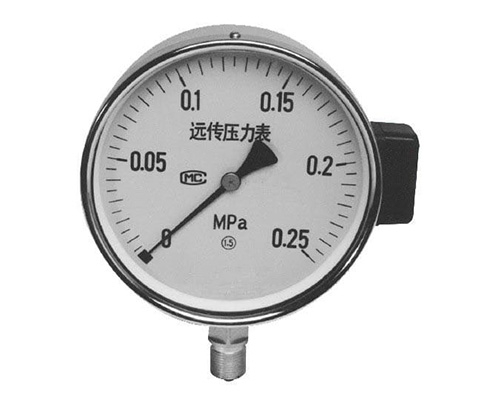
Resistance remote pressure gauge is suitable for measuring the pressure of liquid, steam and gas media which do not corrode steel and copper alloy. Because the resistance remote pressure gauge is set up inside a slide wire resistance transmitter, so the measured value can be transmitted to the secondary instrument far away from the measurement, in order to realize the centralized detection and long-distance control. In addition, this resistance remote pressure gauge can indicate the pressure on the spot, so as to be convenient for on-site work inspection.
2、Main technical indicators
w Accuracy level: 16 levels
wTransmitter starting resistance value: 30~20Ω
wTransmitter fullness resistance value: 340~400Ω
wTransmitter terminal applied voltage not more than 6V
w resistance remote pressure gauge using environmental conditions: -40 ~ 60 ℃, relative humidity is not greater than 85%, and vibration and the measured (control) medium of the sharp pulsations
Should have no significant impact on the normal operation of the instrument.
w Temperature effects: the use of temperature deviation of 20 ± 5 ℃, the additional error of its temperature is not greater than 0.4%/10 ℃.
3、Structural principle
The resistance remote pressure gauge consists of a spring tube pressure gauge and a slide wire resistance transmitter. The role of the mechanical part of the resistance remote pressure gauge is the same as that of the general spring tube pressure gauge. As the resistance transmitter system is set on the gear mechanism, therefore, when the sector gear shaft in the gear mechanism generates deflection, the rotating arm (brush) of the resistance transmitter is also deflected accordingly, and as the brush slides on the resistor, it makes the change of the measured pressure value change into the change of the resistance value, which is transmitted to the secondary instrument and indicates a corresponding reading value. At the same time, the primary meter also indicates the corresponding pressure value.